Showing posts with label NATO. Show all posts

Sunday, 12 June 2016

Checkmate: Russian hypersonic weapons rule out US-NATO naval assault

June 12, 2016 - 
Valentin Vasilescu, Katehon - 


The US rules the globe, having a navy three times stronger than that of Russia. Moreover, the Pentagon has created a strategic command to deploy large units of land forces, consisting of hundreds of cargo ships of large capacity. All of these vessels are organized in very strong expeditionary naval groups and around aircraft carriers, amphibious landing ships, and naval convoys of troops and military equipment.

With troops deployed in Europe and Asia, with the armies of allied states, the US can trigger an invasion of Russia. Therefore Russia's new military doctrine establishes that the biggest risk to Russia's security groups is the American expeditionary naval groups, which can transport invasion troops to the Russian border.

Several types of anti-ballistic shield protect US naval expeditionary groups and zones of landing for troops from transport ships. The first is the naval system AEGIS armed with SM-3 block 1b mounted on US destroyers and cruisers AEGIS, plus anti-ballistic shields in Poland and one in Romania. The second is the mobile THAAD system of the US land forces, defending landing zones. Add to this the mobile long-range missile anti-aircraft batteries like Patriot with anti-ballistic capabilities against missiles that are in their final stage of the path, under an altitude of 35,000 m.

The premise from which Russian experts started building hypersonic vehicles was that American antiballistic missiles cannot intercept any projectile flying in the mesosphere (at altitudes of 35.000- 80.000 m), and that Russia, unlike the US, owns a number of very powerful rocket engines. For example, the Pentagon and NASA cannot send satellites into orbit if Russia does not deliver the RD-180 rocket engines. Russia is on the verge of creating, starting in 2018, the surest antidote to this vulnerability by means of a hypersonic battle. Aerial vehicles are classified according to the airspeed as follows: subsonic (below the speed of 1,220 km/h, - Mach 1) supersonic (speeds between Mach 1 and Mach 5 - up to 6000 km/h), and hypersonic (with speeds between Mach 5 and Mach 10 – up to 12,000 km/h).

Russian hypersonic weapons

The main Russian hypersonic weapon are derived from space glider Yu-71 (Project 4202), which flew during tests at a speed of 6000-11200 km/h over a distance of 5,500 km at a cruising altitude below 80,000 m, receiving repeated pulses from a rocket engine to climb, execute maneuvers and cornering trajectory. It is estimated that the glider is armed with warheads that are spatially independent, with autonomous guidance systems similar to the air-ground missiles Kh-29 L/T and T Kh-25 (which provides a probable deviation of 2-6 m). Although it may take nuclear warheads, the space glider will be armed with conventional warheads and will be powered by a rocket launched normally from nuclear-powered Russian submarines.


Another variant of the hypersonic weapon derived from the Yu-71 would be those launched from the Russian military transport aircraft Il-76MD-90A (II-476). Since 50% of the missile’s fuel is spent solely on take off and rising though the layers of extremely dense atmosphere of up to 10,000 m, mass launcher and glider space represents 50% of the rocket carrier used to launch from nuclear-powered submarines.

The second type of weapon different from hypersonic spatial glider is the Zirkon 3M22 missile, which is launched from maritime patrol aircraft. Zirkon has a speed of Mach 6.2 (6500 km/h) at a cruising altitude of 30,000 m and a kinetic energy at impact with the target 50 times higher than existing air-ship and ship-to ship missiles.


Hypersonic concept for a war

The new Russian military doctrine states that an attack on the American invasion fleet is to be executed in three waves, three alignments, thus preventing American expeditionary naval groups from positioning themselves near the Russian coast of the Baltic Sea. The first wave of hypersonic weapons, consisting of space gliders arranged on Russian nuclear-powered submarines under immersion in the middle of the Atlantic, starts fighting US naval expeditionary groups as they start crossing the Atlantic to Europe. The American naval groups need 7-8 days to cross the Atlantic; the plane Il-76MD-90A has a maximum flight distance of 6300 km and can be powered in the air, reaching the middle of the Atlantic Ocean in a few hours.


If the first wave does not destroy the targets, the second wave of hypersonic weapons will be launched on the US naval groups when they are located 1,000 km from the eastern shore of the Atlantic Ocean. The attack will be launched from the Russian submarines in the Barents Sea or Plesesk base of strategic missiles, located near the Arctic Circle and the White Sea.


The third wave of hypersonic attack will be executed by missiles 3M22 Zirkon launched on American naval groups when they would be in the Skagerrak strait (crossing the North Sea to the Baltic Sea), on the assumption that NATO is attacking Russia through the Baltics. If the American expeditionary naval group head to the Black Sea, it will be hit by the third wave of hypersonic weapons in the Bosporus and Dardanelles straits.


Thus, Poland, the Baltic States, and Romania – all NATO countries that use highly aggressive language and actions against Russia - should think better before triggering a military incident with Russia, since these countries rely only on military aid over the Atlantic Ocean, which might never come.


     Follow us on Facebook!                                                  

              Facebook                                   

       Follow us on Twitter!
              Twitter               

             Donate!

Wednesday, 8 June 2016

Driving through Poland in Anaconda, US military transport kills civilian motorist.

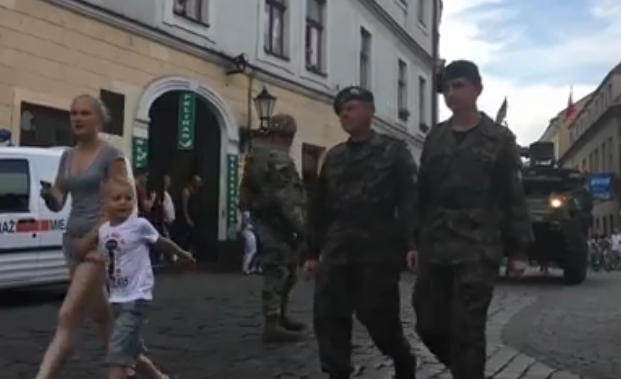
Coming through! Anaconda downtown. Innocent fatality no surprise here! From video at Die Welt site

Die Welt, June 8, 2016
Translated from German by Tom Winter

In the military exercise "Anaconda" a man has been killed and his passenger seriously injured. The man died in a collision of his car with a US military transport, which was part of a convoy driving through Poland.

In the margins of the NATO military maneuver "Anaconda" a man was killed in a car accident.* According to a Polish military spokesman, the driver of a civilian car was killed and a passenger seriously injured when their car collided on a highway in western Poland with a US military transport. The transporter was part of a convoy, which was traveling as part of the military exercises.

24 NATO countries and several countries in the so-called Partnership for Peace involved, including Georgia and Ukraine are involved in the ten-day maneuvers called Anaconda 2016.

Designed for covert attack
A total of 31,000 soldiers, with 3000 vehicles and tanks, 105 aircraft and helicopters and twelve ships are involved in the exercise. The Bundeswehr has sent 400 soldiers. It is the largest exercise in Eastern Europe since the end of the Cold War. The exercise will be close out shortly before the NATO summit meetings July 8 and 9.

The maneuvers, ongoing since Tuesday, are designed for a covert attack and not an official declaration of war. 
Map is from Guardian story NATO countries begin largest war games

Experts suggest** that Russia had applied this tactic in the annexation of the Crimean peninsula in spring 2014, as the military appeared on the peninsula without insignia and the Ukrainian soldiers were enclosed in their barracks.

*
Why not "armored troop carrier accident"?
"Car accident." 3000 military vehicles and tanks, and this was a car accident.
**
"Experts suggest" (Experten vermuten) is Die Welt's equivalent of Fox News saying "Some people say." Omitting little things like the democratic voice of the people in plebiscites is, of course, par for western journalism. -- Tr.

     Follow us on Facebook!                                                  
              Facebook                                   

       Follow us on Twitter!
              Twitter               

             Donate!

Tuesday, 7 June 2016

Finland would rather be friends with Russia than members of NATO -- President Sauli Niinistö

Vladimir Putin, president of Russian Federation with Sauli Niinistö, president of Finland
Sputnik France, May 1, 2016
Translated from French by Tom Winter, June 7, 2016

After the warning from Moscow that Russia will respond with military and technical measures at its northern borders if Sweden decides to join the Atlantic Alliance, Finland, for its part, rejected the idea of joining NATO.

Commenting on a report by an international group of experts on the possible integration of Finland to NATO, President Sauli Niinistö was against any membership, reports Finnish media YLE . "We do not need to change the current policy," said M. Niinisto in an interview with YLE media.

Nevertheless, as every country has the right to decide for itself according to its national interests what form of security is best for the state, the president said it was probably just to ask the people, by means of a referendum. 

Sauli Niinistö also said that Helsinki and Stockholm were to make that decision separately. "We have no automatic reciprocal link on this where, if one country decides to join the Alliance, the other must immediately do the same (...) Each country is responsible for its. decision on NATO," said President Niinisto.

Sauli Niinistö made this statement after the recent warning from the the Russian Foreign Minister Sergei Lavrov that Russia would take adequate measures if Finland's neighbor, Sweden, joined the Alliance. **

Although the Russian minister has said that Russia does not think the Swedes will attack once they have decided to join NATO, Finland has chosen not to poison its relations with its neighbor and partner."They (Russia) do not want the threat approaching their borders," said the President of Finland, who had already mentioned that Russia was a key partner for Finland. This was in his New Years speech, when Sauli Niinistö said that Russian-Finnish relations were among the priorities for his country's foreign policy.

**
Read about Lavrov's warning here.


     Follow us on Facebook!                                                  
              Facebook                                   

       Follow us on Twitter!
              Twitter               

             Donate!

Sunday, 5 June 2016

B-52 Used to Bomb Yugoslavia Deployed to Russia's Borders

Translated by Ollie Richardson for Fort Russ
5th June, 2016


The exercises that are currently being held in the Baltic States will involve two US air force B-52 bombers. This bomber participated in the operation against Yugoslavia in 1999.

US bombers were deployed to Europe to participate in NATO exercises Baltops 2016 and Saber Strike 2016 in the Baltic. It was originally intended to send three aircraft, however, one of them flew to Estonia because of a breakdown, said a source to "Interfax".

The bombers with the tail numbers 60-0037 and 60-0044 were deployed to the Fairford airbase in the UK in 1999, where they were used in combat missions against targets in the former Yugoslavia.

Recall that in history there is an unpleasant fact. During the bombing of Belgrade, the US military wrote a message on the bombs: "Happy Easter!" These bombs then destroyed Orthodox churches.

It is worth noting that in response to the activation of the NATO exercises, Russia's Defence Minister Sergei Shoigu announced large-scale events for the preparation of the Russian army. This summer it is planned to hold more than 2000 different drills.


     Follow us on Facebook!                                                  
              Facebook                                   

       Follow us on Twitter!
              Twitter               

             Donate!

Tuesday, 31 May 2016

Information Released on June NATO Exercise in Kherson

Translated by Ollie Richardson for Fort Russ
31st May, 2016


[Disclaimer: This information has not been confirmed by NATO or related persons or bodies]


During the intelligence activities by the "Odessa" brigade it became known that military exercises under the auspices of NATO will be held on the territory of the Kherson region in the first half of June. Such countries as Ukraine, USA, Turkey, and other contingents of NATO forces will take part.

Military equipment and heavy weapons involved in the above event will arrive and be unloaded at the deep-sea ports of Odessa and Nikolaev. With the above mentioned ports, it will spill over into the territory of Kherson region, namely the venue of military maneuvers.

One of the notable nuances is that the Western-controlled media is silent about these exercises. This occurs despite the fact that previously such plans were preceded any public statements or publication in the news.

In addition, another factor is that the accumulation of troops and military equipment will be in close proximity to the state border with the Russian Federation, namely the Crimean Peninsula.

Also, attention should be paid to the fact that over the past week Israeli vessels, in very small volumes and with an urgent speed, exported concentrated vegetable oil and grain through the Nikolaev seaport. It was very similar to the desire in short notice to remove liquid assets from certain territories. At the same time, given the agility of the Israelis, all this can have an ulterior motive.

The "Odessa" brigade focused on the fact that because of a combination of the information received in light of the aggressive policy of the West, the vassal government in Kiev, and also the created and supported armed groups, it looks quite alarming. Thus, there is a definite probability of a possible aggravation of the military-political situation in the southern regions of Ukraine in the form of armed aggression against the Russian Federation, namely Crimea.


     Follow us on Facebook!                                                  
              Facebook                                   

       Follow us on Twitter!
              Twitter               

             Donate!

Sunday, 29 May 2016

Petition to get France out of NATO


Sortirdelotan.fr, May 28, 2016

Here at Fort Russ, we do not expect that signatures outside of France will be of use, but it seemed that Fort Russ readers would be interested in knowing of this project and in reading its rationale... 

Translation by Tom Winter

Headline:
"At Warsaw they are getting set for war. Let's get out of NATO!

"The next NATO summit in Warsaw July 8 and 9, just one more provocation against Russia. With this appeal, the signatories mean to say "STOP" to this nuclear escalation before something undoable gets done"


Text:
The hour is grave. A new missile crisis is brewing against Russia, a mirror image of the 1962 missile crisis when the Soviet Union deployed missiles in Cuba, at the very portals of the United States. The situation has gotten upside down: then NATO was struggling against the Warsaw Pact; today it meets in Warsaw!

Therefore, we the undersigned, find that we are faced with a provocative policy of encirclement:

1. continuous expansion of NATO to Russia's borders, despite the guarantees given by the West to Gorbachev in 1989 that this would not happen;

2. deployment of the Aegis missile defense shield in Romania, Poland, Turkey, and Spain. Featuring MK41 launch systems, these weapons can be used for defense missions (anti-aircraft, anti-submarine, anti-ship), but also for attack missions against ground targets;


3. deployment in the Baltic countries, Poland, and Romania, by rotation, of four regiments of a thousand men each with permanent military equipment;


4. constitution of a "northern" front against Russia, bringing together NATO members (Denmark, Iceland and Norway) or its Partnership for Peace (Sweden and Finland).


To end this menace we demand:
1. That the French government use the "policy of the empty chair" at the upcoming NATO summit in Warsaw; 

2. that it announce its decision to leave the organization that no longer has any raison d’être. 

We call on France to create the conditions for a return to an order of peace in the world, based on "win-win" cooperation proposed by the BRICS, which Europe and the United States have an interest in joining. 

Let us mobilize today all those means that we have committed in the twentieth century for war, for peace through mutual development!


     Follow us on Facebook!                                                  
              Facebook                                   

       Follow us on Twitter!
              Twitter               

             Donate!

Friday, 15 April 2016

The US wants to turn Skopje into the Balkan Kiev

April 15, 2016 -
Andrew Korybko, Katehon -


The Republic of Macedonia fell victim to the US’ latest regime change destabilization against it, with “opposition protesters” rioting in the capitalWednesday night and even ransacking one of the President’s offices. While Hybrid War tension has been building for some time already and was described by the author in numerous publications before, the spark that pushed them into acting was President Ivanov’s surprise declaration of amnesty for all the people under investigation as part of the “wiretapping scandal”, with the Macedonian leaderremarking that this is a necessary step in order to move the country forward and out of the political quagmire. The Color Revolution elements inside of the country exploded into fury at the announcement, enraged that their attempt to use the newly created and McCarty-esque “Special Prosecutor’s Office” as an anti-government witch hunting weapon had been dramatically foiled. 
The Enemy Within
In response to the sudden spoiling of its ‘constitutional coup’ plans, the US ordered its subordinate Soros-affiliated “NGO” networks and the “opposition” to turn up the heat against the authorities and initiate the progressive rollout of their second preplanned Hybrid War putsch, setting the Color Revolution wheels into motion in advance of what is expected to be a forthcoming Unconventional Warfare complementary campaign. An unpopular spectrum of anti-government “activists” – including ‘Liberal-Democrats’, Cultural Marxists, and Europhiles (essentially one in the same) – flooded into Skopje in a frenzied effort to turn it into the Balkan Kiev, but once more, the professionalism of the security services and the patriotism of the population played a large role in mitigating the immediate escalation of the urban hostilities and in preventing them from getting totally out of control. The threat still remains and the US’ intention to overthrow the Macedonian government is now out in the open and utterly undeniable to all objective observers at this point, but the hooligans were so far unsuccessful in their plan to exploit their series of violent provocations and create an opening to embed themselves in the middle of the city. 
Having taken a day to assess the events of 13 April, they can be seen in hindsight as an unofficial declaration of the US’ second Hybrid War aggression against Macedonia, pushed forwarded a bit from its original launch date due to President Ivanov’s surprise announcement but still close enough to the 5 June early elections to be able to destabilize them. Washington summoned the country’s internal political enemies out into the street in a treasonous act of anti-government defiance in order to intimidate the rest of the country and gin up more support for the movement among society’s most radical elements. The brief period of rioting was also meant as a signal to the Wahhabi/Irredentist Albanians that are under the US and Tirana’s influence (and for some of them, their direct employ) to prepare for launching the next stage of the Hybrid War. This could likely see them staging a Kumanovo-style attack that would in turn activate the Western mainstream media-manipulated narrative that the Macedonian Crisis is a Huntingtonian ‘Clash of Civilizations’ between Muslim Albanians and Orthodox Macedonians, which in any case would complicate the political turmoil by introducing strong shades of identity conflict.  
Nasty Neighbors
Despite being of critical importance to the stability of the entire Balkan region, the Republic of Macedonia cannot depend on its neighbors for help in overcoming the destabilization, and if anything, all of them besides Serbia have hostile intentions towards it. Before continuing, it’s necessary to expand a bit on Serbia’s projected reaction to all of this, since it’s the first country that would be most immediately affected if Macedonia is thrown into mayhem and at least one million immigrantsconsequently exploit this state of affairs in order to flood across its borders. At the same time, however, Serbia is in no practical position to constructively assist its southern neighbor, and even if it did, it’s all but assured that such moves would instantly and deliberately be misconstrued by the West and each of the two countries’ domestic “opposition” movements and transformed into an anti-government rallying cry . Faced with this reality and the much higher subjective priority that Serbia places on its own internal stability and that of Republika Srpska (which is being rattled by Sarajevo’s institutional attacks against it), Belgrade would probably limit any prospective support to Skopje to the diplomatic-informational realm. 
Greece:
To address the nastiness of the rest of Macedonia’s neighbors which believe they have a stake in the country’s destabilization and potentially even ultimate dissolution, it’s necessary to first and foremost speak about Greece, which has ratcheted up bilateral tension lately by allowing repeated NGO-organized immigrant invasion attempts of the Macedonian border. The lingering “name dispute” is what’s to blame for the Greek authorities’ eagerness to subvert their northern neighbors, believing that if the massive pressure incurred by this cresting human wave can succeed in toppling the authorities and installing Zoran Zaev’s pro-US puppet regime in its place, the new “government” might ‘compromise’ on the Republic of Macedonia’s constitutional name and thereby satisfy Athens’ longstanding will. In order to fulfill the mission that it’s been obsessed with for over two decades now, some Greek authorities are utilizing the tens of thousands of Mideast immigrants that are inside the country’s borders as “Weapons of Mass Migration” against Macedonia, anticipating that they can be employed (both figuratively and literally) as battering rams for pushing forward the US’ regime change agenda and tangentially achieving their own self-interests in the process. 
Bulgaria:
The other two neighbors that are interested in the Macedonian state’s downfall are Albania and Bulgaria, each of which have their own “Greater”/Irredentist aspirations to promote. Nearly a year ago during the last major Hybrid War disturbance in the country, the author wrote about how these two states were poised to exploit Macedonia’s misfortunes in seeking to tear it apart and geopolitically divide it between them, whether formally or via de-facto spheres of influence. The next day, Russian Foreign Minister Sergey Lavrov warned his Albanian and Bulgarian counterparts against pursuing this dastardly plot, and shortly thereafter the state-to-state tension lightened to a degree and Bulgaria’s “anti-terrorist/anti-refugee” border buildup was revealed to be the naked instrument of bullying pressure that the author predicted it was in the first place. Still, despite backing down from formally trying to unbalance the state and strategically distract the Macedonian authorities, nationalist elements in Bulgaria remain dedicated to turning what they view to derogatorily be an extension of their own country into an outright protectorate or re-annexed territory, and it can’t be dismissed that similar pressures such as the ones from last year will be repeated in the current scenario. Positive media coverage of the “opposition” and any forthcoming extremist Albanian elements would also function in a ‘softer’ but similar way in helping to promote Sofia’s ultimate objectives. 
Albania:
This brings the analysis around to examining Albania’s role in all of the intrigue, which is the most negative one of them all. Amidst its current immigrant outflow and dwindling domestic conditions, the Tirana elite are eager to redirect rising animosity to their rule towards the convenient distraction of promoting “Greater Albania”. Last year the Kumanovo terrorists were reported to have come from the NATO-occupied Serbian Province of Kosovo, and this time it’s believed that any extreme political-insurgent elements within the country will have the full behind-the-scenes support of the Albanian establishment. When it comes to the potential for Wahhabi terrorists and Daesh cells to rear their heads amidst any future conflict, Tirana would probably play a backseat role to all of that by allowing its Turkish ally to take the lead in handling these sorts of terrorists operations, just as it has battletested experience in doing over the past half a decade against Syria, and likely offering up its territory for this purpose. Furthermore, the US already has a brand-new terrorist organization waiting in the wings to act, the “Albanian National Army” that just sprouted up in occupied Kosovo and conveniently, in the reported words of one of its ‘commanders’, “considers NATO to be its friend”. The Albanian-American-Turkish terrorist nexus along the non-Tirana-administered areas of the envisioned “Greater Albania” (NATO-occupied Kosovo and western Macedonia) will definitely play a determining factor in any forthcoming Hybrid War scenarios and presents the utmost greatest threat to regional stability. 
Chaos At The Gates
Targeting Multipolarity:
The Republic of Macedonia is at the literal forefront of the US’ War on Europe, as the author explained in a prior piece for Katehon pertaining to the Immigrant Crisis. It’s recommended that the reader review the aforementioned citation if they’re not yet familiar with the author’s analysis on this topic, but the general idea is that the US is employing “Weapons of Mass Migration” in order to place the EU into a permanent state of Hybrid War tension and facilitate the Color Revolution removal of leaders that have pragmatic engagement with Russia and China. On a more regional level, the US is targeting the Republic of Macedonia and Serbia because they’re the key bottleneck states in actualizing China’s Balkan Silk Road project, which if completed, would complement Russia’s currently suspended Balkan Stream gas pipeline and together create the infrastructural backbone of a multlipolar future for Europe. 
Regional Tidal Wave:
Hybrid War in and of itself is destabilizing for any country and region that suffers from its most intense manifestations, but the most direct and debilitating form of chaos that it immediately leads to is an outflow of immigrants/refugees/undercover terrorists to and from the battlespace. This takes on a particular significance in the present day given the ongoing Immigrant Crisis and Russian Prime Minister Dmitry Medvedev’s February dire warning to the world that “hundreds and thousands of extremists enter Europe under the guise of being refugees.” The Republic of Macedonia is literally on the frontlines of this crisis and has amazingly stood strong in the face of the overwhelming odds against it, but faced with the recent commencement of Hybrid War within its borders and the possibility of the Color Revolution disturbances transforming into an all-out Unconventional War, it’s uncertain at this time how effectively it’ll be able to hold out. 
Structural Vulnerabilities: 
Greece’s repeated border subversions and the culpability that some of its government authorities and hosted NGOs have in worsening the Immigrant Crisis and funneling its most destabilizing elements northward to Macedonia can expectedly be taken to mean that the security services will have their work cut out for them in juggling the nascent Color Revolution threat, snuffing out any Unconventional Warfare ones infiltrating in from Albania and/or NATO-occupied Kosovo, and securing the border from an outright immigrant invasion. Furthermore, if Bulgaria once more decides to provocatively send troops to the Macedonian border amidst a rapidly escalating climax of the situation, then it could have the effect of stretching the Macedonian authorities’ concentration much too thin and opening up strategic vulnerabilities on one of these multiple fronts that could then be instantaneously exploited by the US and its allies in accordance to their many preplanned and forecasted scenarios. The end result of a successful regime change in Macedonia would be the barbarian-like storming of the country’s territory and an uncontrollable surge of up to one million immigrants right through the heart of the Central Balkans, precisely at the moment in time when the regional states had begun to finally breathe a collective sigh of relief that the worst point of the crisis was behind them. 
Reinforcing The Front:
In dealing with this possible eventuality, it’s necessary that the Macedonian authorities receive some sort of multilateral physical support from the same stakeholders that most immediately have something to lose if the government falls and becomes a doormat for the US’ “Weapons of Mass Migration” to invade Europe. Right now, as the author previously analyzed in an article for The Saker, the status quo equilibrium and the de-facto closure of the “Balkan Corridor” is presently maintained by joint the Austrian-Hungarian leadership that brought all of the Balkan states together and got them to overlook their bickering in favor of pursuing a collective and coordinated solution to the problem that plagues them all. The most effective way to proactively counter the chances that the incipient Hybrid War in Macedonia will demolish the border ‘floodgates’ and inundate Europe with an uncontrollable flow of “Weapons of Mass Migration” is for this temporary Central European-led security structure to take on a heightened role (by official Macedonian invitation, of course) in patrolling the Greek border and thus giving the authorities more flexibility in responding to the US’ other provocations. 
Concluding Thoughts
Macedonia convincingly appears to be on the brink of a large destabilization, a second Hybrid War that’s directly targeting its government but is also indirectly aimed at destroying the prospects that Russia and China have for progressively liberating Europe from unipolarity. Washington has thrown down the gauntlet, as expected, in using its proxies to send a strong message to Skopje that its democratic security methods in foiling the “Special Prosecutor Office’s” ‘constitutional coup’ plot and in protecting Europe from the uncontrollable ravages of the Immigrant Crisis will be met with the harshest asymmetrical response possible. 
The growing threat that a full-scale Hybrid War will break out in the Republic of Macedonia is very high, and the Moscow-based Katehon think tank wisely suggeststhat harsh anti-riot measures be immediately implemented in order to contain the Color Revolution threat. If the authorities can get a handle on dealing with this latest destabilization before it gets out of control, then they’ll be in a better position for responding to any predicted “Greater Albania” and/or Daesh terrorist attacks that might break out before the 5 June early elections. If these two pressing internal threats can be effectively neutralized, then Macedonia won’t be as vulnerable to the direct subversion that its Albanian, Bulgarian, and Greek neighbors are plotting against it with American and Turkish ‘Lead From Behind’ assistance.  
If worst comes to worst, then Macedonia could greatly benefit from multilateral assistance in reinforcing its border with Greece so that its security services could more easily react to internal provocations as they arise, which would thus enable the government to put down any destabilizing domestic disturbances while relying on its international partners and equal strategic stakeholders in protecting the southern border from a “Weapons of Mass Migration” invasion into all of them. The less than two-month period before the election will be absolutely critical for the stability of the Balkans and the rest of Europe, but if history is any indication, then just as they did last year around this time, the Macedonian people will legendarily succeed in knocking out the Hybrid War threat that the US is once more siccing on them and ultimately landing Uncle Sam another embarrassing black eye. 


     Follow us on Facebook!                                                  
              Facebook                                   

       Follow us on Twitter!
              Twitter               

             Donate!