Showing posts with label Protest. Show all posts

Friday, 10 June 2016

(PHOTOS + VIDEO) 50,000 rally in Donetsk against armed OSCE mission

June 10, 2016 - 
Marina Russkaya, PolitNavigator - 
Translated by J. Arnoldski


A mass rally of residents of the DPR was held today in Donetsk. More than 50,000 people marched in a column along the city’s central street to protest Kiev’s intention to introduce an armed OSCE mission in Donbass. 

The column marched from the N.K. Krupskaya Library to the central Lenin square. The demonstrators carried banners in different languages including English, German, French, and others and appealed to the international community not to allow the deployment of an armed mission. Posters bore the inscriptions “No armed OSCE mission,” “We’ll protect ourselves,” and “Armed OSCE mission = military intervention.”

On Lenin square, the crowd was addressed by activists, political figures, and top officials of the Donetsk People’s Republic.


“We saw the shelling of Volnovakha. We saw the shelling and murder of international journalists, and we together know how Ukrainian sabotage groups, dressed up as our soldiers, have worked. Therefore, we are here to day to say ‘NO” to an armed OSCE mission. Friends, today the residents of the DPR have come out to this square to stay their position to the whole world. For two years together, we have participated in the construction of our young state, and we see how our law-enforcement agencies are guaranteeing order. They are adequately handling this. We do not need an armed OSCE mission!,” the deputy of the DPR People’s Council from the “Donetsk Republic” organization and leader of the social organization “Young Republic,” Sergey Kondrykinsky stated.

“Hear us! I recall how Taras Grigorovich Shevchenko said in Russian: ‘He who does not have love for his native country has the heart of a crippled beggar.’ [These lines] are about them. About those who are shooting at our homes, at our unarmed people. About those who are not fulfilling the Minsk Agreements, and those who want to put a fence between us and Russia,” Donetsk resident Olga Zhukova said in a speech at the rally.


The head of the People’s Council of the DPR, Denis Pushilin, summed up the DPR public’s position: “We have gathered here to say a firm ‘NO’ to an armed OSCE mission in Donbass. For us, it is absolutely clear that the deployment of an armed OSCE mission to our homes means a complete severing of the Minsk Agreements. Now Poroshenko is telling the whole world that the mandate of the OSCE mission needs to be changed - the mandate which was supported by the OSCE itself and the UN Security Council. This is unacceptable for us. But for Poroshenko this is profitable. He wants to make a third party, an armed side of the conflict, out of the OSCE. But we together understand armed observers will be easy targets for the armed forces of Ukraine and, according to tradition, they will try to blame us. An armed OSCE mission in Donbass is a complete contradiction of all hitherto reached agreements, a breakdown of all formats. This is unacceptable for us. We understand that our own law-enforcement agencies can protect our security. We don’t need anyone else. Such a mission has no place in Donbass. Dear friends, we have already handled things, and we are handling everything now. We have offered our weighty word.” 


     Follow us on Facebook!                                                  
              Facebook                                   

       Follow us on Twitter!
              Twitter               

             Donate!

Friday, 3 June 2016

Ukrainian "Titanic" heading straight for iceberg: Kiev analyst points to coming scandals, protests

June 3, 2016 - 
Translated by J. Arnoldski


The Ukrainian political analyst and herald of the regime, Vadim Karasev, whose assessments are usually the most optimistic among his colleagues, has suggested that an “iceberg” can already be seen under the Ukrainian “Titanic.”

The “rats” are bankrupting their own banks and are already packing their bags - yet another Khrshchatik Bank scandal. But rather than repeating what Karasev himself has already posted on his Facebook page, here is the full text: 

“Savchenko compared the parliament to the Titanic, but I would said that our entire ruling elite is the Titanic. The iceberg of a new wave of protests is getting closer, but almost nothing is being done to change course or stop the state vehicle from being used for enrichment.

In the new future, according to many financiers, we’ll have another high-profile corruption scandal linked to the Khreshchatik bank. 

Law enforcement officials, the Fund guaranteeing rival contributions, are rushing to declare that they’ve withdrawn their funds from the bank because the bank doesn’t guarantee securities. But what is really going on? According to bankers, the situation is the opposite - Khreshchatik has left a number of estates, land, and gold, etc. as collateral to the tune of billions. How can all of this be sold to their people for a pittance? Even disregarding the press releases which report that the bank’s loans are fictitious, the collateral is not in any way in danger. And then there will be one too many questions: where did the bank’s property disappear to? We are witnessing such a special information operation now.


Some officials from far from low ranks have fully mastered raider techniques. Including informational ones. These skills will definitely come in handy for “working” with the peaceful protests about which Leshchenko has spoken and about which Savchenko will probably soon enough also speak.” 


     Follow us on Facebook!                                                  
              Facebook                                   

       Follow us on Twitter!
              Twitter               

             Donate!

Thursday, 14 April 2016

(VIDEO) Joaquin Flores to RT on Macedonia: "Western powers are mobilizing the minority against democratic processes"

April 14, 2016 -


Joaquin Flores of Fort Russ, the Center for Syncretic Studies, and the Independent Journalists Association for Peace (AJKF) appeared on RT to discuss the latest turmoil shaking Macedonia.

Flores stressed that although many Macedonians may have legitimate grievances against the current government, the latest violent protests in response to wire-tapping scandals are merely another Western attempt at subversion. "Many Macedonians are right to be outraged about certain things. However, there is strong evidence - conclusive evidence - that much of this protest has been hijacked by Western powers in order to subvert the sovereignty of the state of Macedonia," Flores said.

The zig-zagging crisis in Macedonia, according to Flores, has to be understood in the larger context of NATO's pressuring of the Balkan states to cede more leeway and rights for entrenching its hegemony in the region. On this note, one of NATO's long-standing objectives is the removal of the somewhat resistant Macedonian government presiding over an increasingly polarized society. 

When asked whether or not the new protest tide could culminate in a coup, Flores stressed that everything depends on the state's actions and on the resistance of the majority of Macedonians who oppose foreign intervention. Flores recalled that the recent coup-attempt by Western-backed protests was beaten back by anti-NATO, pro-government mobilizations which outnumbered the "opposition" by nearly three times. In the end, Flores recalled frankly, it's important to remember that EU and NATO membership would devastate large swathes of ordinary Macedonians and their livelihoods.

"Now they [Western powers] are resorting to taking a minority of the population, albeit a sizable one, having them mobilized on the streets, and work against the democratic processes that have already decided the present government in Macedonia," Flores explained.

Overall, Flores predicts that the situation will simmer down as long as the current authorities act cleverly, calmly, and refuse to give in to Western-backed protest siege. 


     Follow us on Facebook!                                                  
              Facebook                                   

       Follow us on Twitter!
              Twitter               

             Donate!

Tuesday, 12 January 2016

Montenegro NATO membership: "to be or not to be?"

January 12th, 2016 - 

Fort Russ - By: Alexander Prokopiev, PeaceKeeper.ru - Russian Military Review - 

Alexander Prokopiev is a member of the Russian State Duma, - 


[FR Note: The political process to make Montenegro a NATO member has been characterized by a large public opposition to it. Montenegro has been the target of information warfare, ideological warfare, and has been subjected to revisions to its collective, social, or national identity. Historically part of the Serbian sphere, it also has minority Albanians, Bosniaks, and Croats. Census data on demography is misleading on the Serbian question, because the majority of Serbs and 'Yugoslavs' will shift from identifying as 'Montenegro', then to Serbian, and back again - depending on the local politics and regional geopolitics.  The entire population on record is about 600,000, but normally the inhabiting population is much less, with as much as half of the population living in Serbia, and to a lesser extent, several of the surrounding larger states like Bosnia and Croatia. 

Also, this cannot be separated from the Syrian conflict, where Russia maintains a military base in Tartus. Historically, dating back to the Great Game of the 19th century, Montenegro as part of Serbia was recognized by the British as being Russia's port to the Adriatic and, with Turkey controlling the Bosphorous, to the Mediterranean. Russia's success in Syria has pushed NATO to move more aggressively on Montenegro.

Additionally, this NATO activity is part of two related processes - one, the expansion of NATO into the Balkans and Eastern Europe, contrary to agreements between NATO and the then Warsaw Pact leadership regarding post-Soviet space and the development of Peace. And two, the dismembering of Yugoslavia and Serbia. Montenegro was a part of Serbia, maintaining the vestiges of Yugoslavia following the NATO war on it, including the instigation of the internecine civil war which saw the deaths of hundreds of thousands, topped off with the bombing campaign of Serbia and its heavily populated capital, Belgrade, directly by NATO in 1999.

Then, the US and NATO was able to pull off a political coup in 2006, in the form of a still unpopular formal secession from Serbia in June of that year.  J. Flores, editor]

During the summit in Brussels on December 2, 2015 NATO member states' foreign ministers have decided to invite Montenegro into the Alliance. But that doesn't mean an immediate membership for the Balkan republic. NATO Secretary General J.Stoltenberg concentrated his attention on the issue saying: "It's just the beginning. Montenegro has to continue intensive reforms, especially in the sphere of fighting corruption and strengthening people's support for Montenegro's NATO integration."

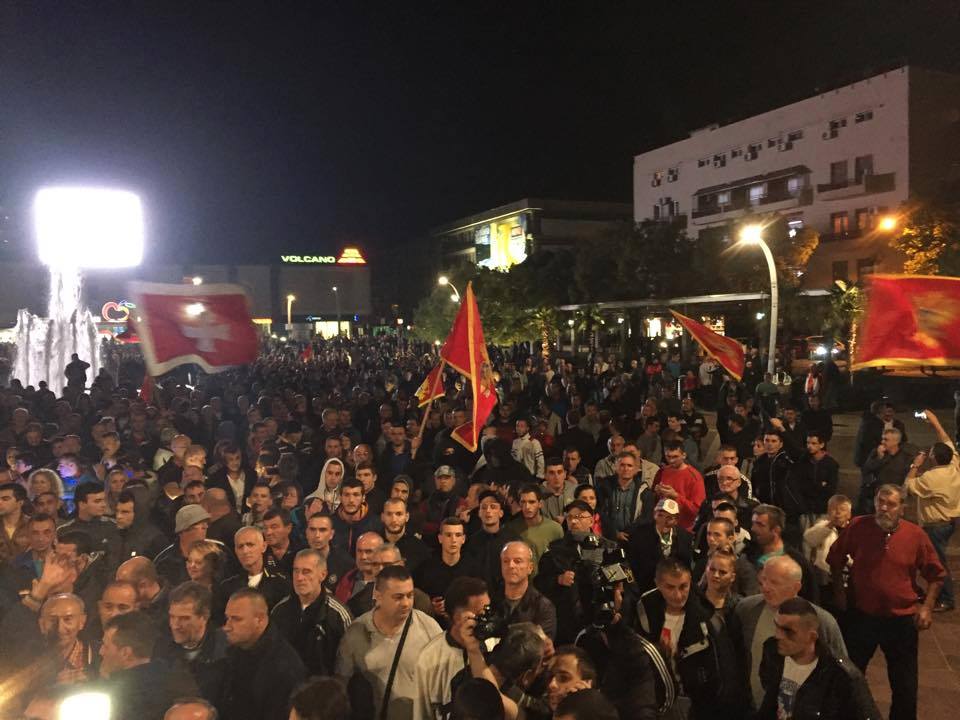
Now, after a meaningful dialogue between Brussels and Podgorica has begun, NATO member states' authorities need to answer two important questions: is NATO ready to accept Montenegro, and another - is Podgorica ready to join. One should clearly understand that this historical decision for a small Balkan country came amid a sharp escalation of protest activity in the republic, largely provoked by the country leaders' intention to drag Montenegro into NATO ignoring public opinion.

For over two months Montenegro has been suffering a series of mass protests. Citizens demand resignation of the country's prime-minister M.Djukanovic and his administration and the forming of a transitional government which should conduct fair and transparent elections. Also the protesters are against joining NATO. The majority of Montenegrins clearly understands that NATO membership will dramatically worsen their traditional relations with Russia, which will cause damage to the country's economy. Montenegrin tourism sector and the real estate market will suffer severe damage, not mentioning that almost 30% of country's factories are owned by Russian citizens.

It is worth mentioning that only 50 Montenegrins expressed their desire to join NATO. Not 50 percent of the population, but exactly 50 people – it's the number of Montenegro parliament members that in September 2015 voted 'yes' for NATO integration.
While one third of the lawmakers voted against integration. Public opinion was ignored, and the country's government provided their Western "colleges" with a few falsified opinion polls' results that were supposed to show a high level of support for the integration. Meanwhile, most of unbiased surveys and independent experts show that up to 70 percent of citizens do not approve integration.
Besides that, the republic's army is few in numbers and poorly equipped. It requires significant investments, which Podgorica can't provide itself. It means that Montenegro is of no use to Alliance's collective security, if not an additional pain in the head for Joint Armed Forces Command. At the moment, only four NATO member states keep their military spending at a necessary level of 2 percent GDP. And Montenegro is not likely to become the fifth.

Besides the financial aspect, the small Balkan state can bring damage to Alliance's image, and become a source of destabilization of the military-political situation. Should the Alliance invite a state headed by a criminal authority, well known by his records both in Montenegro and abroad? NATO leadership is already having severe difficulties because of another member state's reckless actions, namely Turkey, that has been accused of aiding terrorists.
According to Russian and foreign media sources, the weapons used in a terrible terrorist attack in the capital of France, were acquired by terrorists from military supply depots in Montenegro. This insight makes one think of whom the Europeans want to see as an ally in the fight against terrorism - M.Djukanovic? He is ready to house a "Muslim ghetto" comprised of the refugees from the Middle East. Practically he's planning to legalize the participants of radical Muslim organizations, fleeing along with the real refugees, in Europe.
Therefore, one cannot say that Montenegro is a desirable partner for NATO. The United States are the ones mostly advocating the republic's integration. But the leading European countries disagree with Washington on that matter. This is evident from the statements made at a seminar dedicated to France and NATO relations, conducted by Paris Institute for Policy Studies on November, 27. The perspective of Montenegro joining NATO received negative assessment during the event, mostly because of nontransparent and corrupt leadership and lack of public support to Euro-Atlantic integration process. Besides, it was considered inappropriate to invite Podgorica to NATO at this time, because it will inevitably complicate relations between Russia and NATO. Meanwhile it's an alliance with Moscow that is considered by Paris to be the single right way of fighting against terrorism. At least, as it became clear from the devastating terror acts in Paris, NATO cannot protect Europe against terrorist attacks.
Eventually, despite the decision, announced on December, 2 by J.Stoltenberg, the question stands: will the Alliance risk accepting 50 Montenegrin politicians along with M.Djukanovic and his criminal elements? For whom the Alliance carries out this "open doors" policy?
Even before the starting of the NATO summit, the opposition coalition of "Democratic front" had announced their will to hold another rally in Podgorica on December, 5. This makes at least one thing clear: if Montenegro authorities continue their way into NATO while remaining deaf to its own citizens – tens of thousands of people will once again take the streets and their demands will transform into ultimatums.
Thus "to be, or not to be" a NATO member state is the main question for Montenegro. Do other European countries need it – is a question for the international society.