 Original by Yevdokia “Dunya” Sheremetyeva published on littlehirosima blog; translated from Russian by J.Hawk and originally published at South Front. November 30th, 2015
I visited a hospice for the second time in my life.What did I experience?Nothing. Emptiness.A place where people die.The Gorlovka Hospice.In the bombed out, abandoned to its fate, unfortunate Gorlovka.
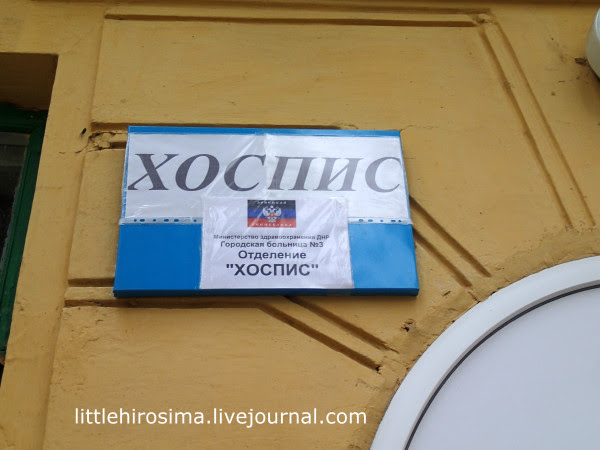
I occasionally get asked– are there hospitals there? Are there retirement homes?Even orphanages that are still open?Yes, it’s all there.And life there goes on as usual, sort of.There are markets, shops, barbers.People go to work. Travel on buses. Haggle on the markets.Choose presents.
And there are also hospices. Where people stayed and worked, despite getting no salaries at all for the last year.Who did not abandon the patients even under rocket and artillery fire.
And the fighting there continues still…

We drove up to a tiny building.One of the nurses walked out of the hospital.She wore heels and tight jeans.The heels clattered on the pavement as the girl walked with her head high.All the men turned their heads.Life continues.
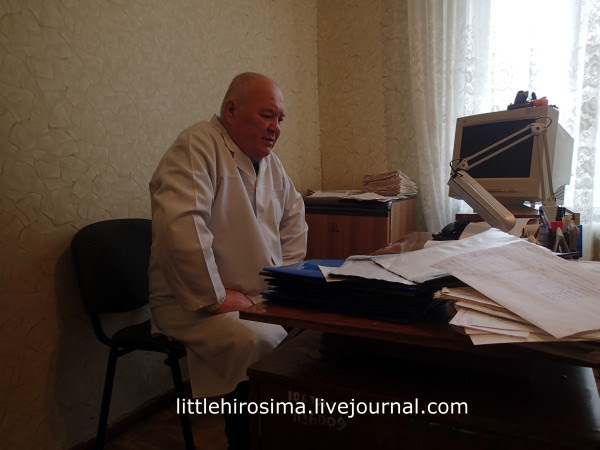
–How are things? Did you get chewed out for keeping our humanitarian aid?–No big deal, we know how to fight.
Nikolay Nikolayevich, the hospice director, smiles.But behind it, his face looks dead tired.I later learned that he suffered a heart attack after we left the Donbass the last time.
In general, it seems that nearly all my friends’ relatives are now suffering from illness of some kind.It’s the stress.Which is now routine.
–I read your article about us. I also saw some of the comments…Yes, some of the comments boggle the mind.I got used to them. That’s a given for me, to read every day that I am a piece of dirt.But Nikolay Nikolayevich is not an internet addict.
He got up and started to look for something in his papers. I look and he’s holding the article complete with comments.–Look what garbage they are writing about you – that you were wearing short shorts…–It’s no big deal…–It’s wrong, wrong.Wrong, wrong.All of that chatter in the net.Empty chatter.
I still struggle to understand what kind of people work here.Nearly all of them were at work during the fighting in Debaltsevo – dozens, hundreds of refugees came through here.Slept on their floors. Slept everywhere.
The workers did not abandon the patients. When water was cut off, they brought up buckets from the flooded basement, boiled it, and used it to wash the dying.For a while they were cooking on a campfire outside.
I hope we’ve made their lives a bit easier.The hospice has the lowest priority when it comes to humanitarian aid distribution.Nobody needs the dying.Not even their own relatives.
What incredible emptiness.When I write about it in the well-fed Moscow. As if a dispatch from a parallel universe.This place where people die.The Gorlovka Hospice.The bombed out, abandoned to its fate, unfortunate Gorlovka.

===You, too, can contribute to helping the people of the Donbass. Contact me in person through my livejournal account, through Facebook, PayPal (Littlehirosima@gmail.com), or via email: littlehirosima@gmail.com.
Original written by Yevdokia “Dunya” Sheremetyeva and published on her littlehirosima blog; translated from Russian by J.Hawk and originally posted at South Front. October 12th, 2015 –We’d like some Spanish literature.
–Hmmm….Borges?
–Something merrier. Do you have Don Quixote?
–For whom are you buying?
–We’re heading for a retirement home. To see an old guy. In the Donbass.
The bookstore suddenly came to life. The staff dropped everything and went off to look for books for us. We arrived at the retirement home at high speed and with a great deal of noise.
–We’re here to see Yuriy Loginov, please!
I’m walking with a purpose.
The packages I’m holding are so heavy, my hands are barely holding them.
Packages of letters and post-cards from the whole world–Germany, US, Australia, Turkey, for the elderly and for Yuriy personally. Then there are books.
Zhenya is walking behind me with bags of cookies, candies, and gingerbread, and is trying to stop my freight train. But it’s no use–the boiler has been stoked, and steam is coming out of every crack.
The nurse is confused:
–Loginov? I don’t even know where his bed is.
–I know–on the second floor. Take us there. To the left.
Yuriy was holding a book, just like last time.
–We’re here to see you. Remember me?
Yuriy did not react - too astonished.
I sat down on the floor next to his bed and started taking out letters. Letters written especially for him, after I posted about him.
The whole blanket was covered with post-cards, and we still needed to find room for all these candies and cookies. And tell him about the books.
–You read English?
Yuriy, chained to this spot for all eternity, not having any relatives and living his internal life, simply has dropped out of reality.
–No, but I used to know German pretty well.

–Well, unfortunately, this German woman sent you a letter in English.
–Please translate it. May I have a bun?
Yuriy's manner of speaking is very cultured and polite. As if he were a university professor in his office. I’m always embarrassed to use jargon when speaking with him.
Right there, on the floor, I start to read one letter after another.
My head is spinning. For some reason there are tears in my eyes.
Yuriy began to cry. And I keep on reading.
One card, then another.
Dear God, people, can you imagine what you have done for him with your letters?
Just don’t cry, OK?

–"Yuriy! Write me a letter!) I am leaving a photo for you, and you send me a letter".
–I have nothing to write on.
But we foresaw everything. We brought notepads and pens with us.
While I was making a mess on the floor, Yuriy’s neighbor rode into the room in his wheelchair.
I’m gesturing to the nurse. She half-whispers…
–It’s Ivan Ivanovich Shargorodskiy.
I’m grabbing Kordula’s post-cards–she’s an awesome woman from Germany who sent post-cards with chocolates in which she touchingly wrote in Russian, using an internet translator, about “greetings from Freiburg to dear grandpa.”
–Ivan Ivanovich, she wrote to you too.
Ivan Ivanovich got a confused look on his face, then softly smiled while his hands were filled with sweets, which they simply don’t get at the hospice.
–Wow, thanks.
I also had a bag of homemade post-cards from the Moscow Psycho-Neurological Dormitory No. 18. A remarkable girl by the name of Zhenya Birman gave them to me to pass on to the old folks. They are all different and signed. Colorful papers, cut-out newspaper articles. You can see the gaps where cut-outs were re-glued many times, because they weren’t evenly spaced the first time around. They were made with a great deal of commitment and love.
When Zhenya was asked about the dormitory, she answered: “A few years ago we somehow organized ourselves into a group of volunteers to go there on the weekends and do what we could. Mostly group activities: art therapy (we draw, sculpt, glue, cut out), literary circle (we read a poem with them, roleplay, etc.), in the summer we play various games outside, there are individual activities with those who can. I, for example, teach one girl math, sometimes we take someone who is allowed to go outside for a walk. We also provide physical labor to the institution. We painted fences and benches, planted flowers, organized a party. The people who live there are adults, 18 years and older, some have parents or relatives who visit, others are orphans who spent their entire life in the system. The department has people with various developmental “particularities.” But not severe cases, they are all capable of communicating, some of them are genuinely bright, though their behavior is a bit off because they don’t know any other life.” There are such amazing volunteers in Moscow, and they got involved in organizing post-cards for the abandoned elderly of the Donbass. I sent a photo today for Zhenya–she simply answered “Hurrah! I’ll make copies and bring to my people. How wonderful.” See? “My people”? It’s Yuriy, Seryozha Kutsenko, they are already “mine.” The natural cycle of goodness.
And these post-cards made it to the Home for the Elderly in Rovenki.
–This is Nikolay Maksimovich Prudnikov! It’s his 83rd birthday. It just so happened that we showed up on his birthday.
Nikolay Maksimovich is missing one hand, but he is fully alert mentally.
This is Aleksandr Levenko–he is blind, but understands everything.
I got a cardboard postcard. There are many cut-outs inside. And a huge butterfly glued to the outside.
–Here’s a big butterfly. Can you feel it?
Aleksandr takes it from me while looking through me, and starts feeling it. The butterfly moved its whiskers under his touch.
Aleksandr smiled so broadly that everyone around laughed.
–Here are some candy for you!
He couldn’t even find words. He was flabbergasted. Here’s another girl, Galya. A journal editor. Lives in Turkey. She loves the sea and diving. Like me. She found me by the metro with a package of letters: “pass them on to the old folks.” Galya is a beauty with three kids–and she wrote touching letters. I vilely read them, since the envelopes were not sealed. They are simply astounding. All different, no two alike. All expressing great concern. Each with a soul.
And we delivered all these letters and post-cards. We didn’t do it all ourselves–there wasn’t enough time, many patients slept when we came, others were taking their walks. There were many letters. Some were in English and I had to translate them. Others were emailed, and we printed them out.
Before leaving the Home for the Elderly, the nurse took me to Zinaida Andreyevna Antipova’s room. She’s only 69. To be honest, I didn’t even understand how she ended up there–she’s an energetic and friendly woman. She could be digging up her garden and feeding her grandkids jam. She has a son–he’s the one who dropped her off here, and he doesn’t visit. He simply never shows up. Perhaps he left the region for good…
She’s been at the Home for four years. After talking to her I was about to leave when a man walked into the room.
I’m thinking–what’s this? Men and women live quite separately from one another here.
While I was thinking, the man walked up to me:
–Dunyechka, you don’t remember me?
Quietly and softly–and fatherly.
Right! The last time he helped us unload the sweets and the diapers.
He remembered not only me, but also my name.
It turned out to be her husband, Nikolay Antipov, 70.
They got to know each other here, at the Home. Got married a year and a half ago. She took his name.
He also has a son. Who also doesn’t remember him.
But now they are together. Just look at them.
–Can I photograph you together?
–Just a second, I’ll comb my hair, wait, Dunyasha! Kolya, take off the bandage!
They got busy. Kolya lovingly says to her:
–Zinochka, you are my most beautiful no matter what!

We were alone in the room. Zhenya and nurse had left.
I held on to the Antipovs, and they held on to me.
–Will you print us a copy of the photo with you?
So I had to make a selfie.
But I don’t know how to make one)
When people do nice things for you, you want to reciprocate. When people compliment you, you grow wings. When they think of you and give you a present from their soul, your heart fills with warmth which you wish to share. And the more caring you share, the more people share it with you, in a cycle. And so on, to infinity.
I am getting banal and boring, but one thing is coming to my mind–one has to multiply the goodness. Breed it, grow it. You simply can’t imagine what you’ll receive in return.
If you want contribute to humanitarian assistance to the people of the Donbass, contact me in person through my livejournal account, through Facebook, PayPal, or via email: littlehirosima@gmail.com

June 16, 2015
The Situation on the Donbass
By Yevdokia "Dunya" Sheremetyeva
Translated from Russian by J.Hawk
[To view Yevdokia Sheremetyeva's other dispatches from the Donbass, click on the "littlehiroshima" tab above the title.]
I have long wanted to write about the humanitarian situation on the Donbass.
I'll say right at the start that I am writing on the basis of my personal experience, and the experience of humanitarian workers who are personally known to me.
I know the situation in the Lugansk District relatively well, but not in the Donetsk one. Many say it's pretty much the same, thought they get more deliveries.
Donbass retirees have been receiving their pensions during the last two months (1200 hryvnia=2400 rubles). Plus various benefits for the disabled, single mothers (870 hryvnia), etc. But pretty much all information had to be resubmitted for the latter.
One cannot say this is enough to save the situation, but I do see a major difference in comparison with the winter.
In December-January the situation was catastrophic, at times one could talk of famine, without exaggerating.

Many towns and villages received no aid at all, for example, Khryashchevatoye, Georgiyevka.
Khryashchevatoye just recently had its electricity restored, though it still lacks water supply in some parts.
During the winter the people were simply surviving. Without any help. "Not in the war zone"--most of the aid went to the regions that were directly affected by fighting, such as Debaltsevo, Chernukhino, and others. The small villages were all but forgotten.
Pervomaysk in winter was a disaster zone. Nothing was delivered since last summer. The city was, and pretty much still is, almost in a UAF/National Guard encirclement. It's been more quiet lately. Although most recent reports suggest they've been shelling it again. And not half-heartedly.
When we made deliveries to communal kitchens, the workers there were practically in tears. And it wasn't an act.
Children in the bomb shelters threw themselves at candy which they haven't seen for so long.
Now both the bomb shelters and the kitchens receive regular food deliveries.
It was obvious in the homes we visited that they were absolutely empty of food. Now it's clear there is food.
However, people have spent the last year living on canned meat, grains, and other non-perishable foodstuffs (tea, sugar, powdered milk).
That's the top priority for deliveries, which makes sense.
Many of those who still have farms survive thanks to them. A cow, goat, chickens, ducks, etc. Though many have to be slaughtered, as there is no feed...
However, those who have spend that entire time in the cities, and those who have lost everything due to shelling (and there are many of those) haven't had an opportunity to drink fresh milk this entire time. People are beginning to suffer from vitamine shortage as a result of eating only processed foods.
That's why during our last trip we tried to buy on the spot a chicken, milk, yogurt or kefir, butter (some haven't seen it for a year) eggs, to add to our food packets. We always tried to bring some fruits for the kids--bananas, apples (which can be bought relatively cheaply on local markets). You can see those on our photographs.

But the biggest problem right now concerns the working age population. Many simply have no work. Those who have it don't receive salaries. The retired and children get aid of some sort. But the healthy adults get almost nothing. They are now the most vulnerable segment of the population. It's hard to imagine, but the physicians, nurses, first aid teams who drive out to help during curfew, firefighters, utility workers rebuilding the city's infrastructure under bombardments, don't get paid.
My friend Yulya is a social worker. She doesn't get paid, but she still has to buy four bus tickets every day (she has to get to the other side of Lugansk). Her relatives help, but she lives off her parents' pension (which they received for only two months during the whole year) and humanitarian aid.
The situation with medicines is equally catastrophic. Pharmacies are empty--only streptocides, analgesics, activated charcoal, etc. If you need anything else, it's a problem.
We get constant requests for medicines. Some people even offer money--"Please, we'll pay, but there is no place to buy it here." It's especially hard for people who need the medicines to remain alive. For example, the diabetics. While insulin is being delivered, it is often of poor quality, which is why many diabetics' condition is worsening. On top of that there's a problem with the quality of nutrition (which is fatal for those suffering from sugar diabetes), freeze-dried foods, lack of fresh vegetables and fruits.
With all that, I thought it astonishing that the shops have everything. You can buy all the necessities on the markets and in shops (though there aren't many of them--the majority have closed). The shelves are stuffed. But people simply have no money. So only the few can take advantage of it, those who had money before the war, or those who get help from relatives. It's a crazy line of alienation, no other way of putting it.
On the plus side, the planting season is in full swing. Everyone is gardening. So long as the shells don't fall.

So overall the situation has gotten better. But it's not all fine and well yet.
The working population is in a very difficult situation--there is no money at all, and humanitarian aid only helps them survive.
There still exists a serious problem with fresh, perishable, foods and medicines. Another humanitarian disaster can occur in the event of an offensive. Because it is always the civilian population that is the first to suffer, and the civilian infrastructure which, as experience shows, are deliberately targeted.
Many humanitarian workers wouldn't go in the face of shelling. And then the deliveries would stop.
And, as always--
If you want contribute to humanitarian aid, contact me through my livejournal account, through Facebook, or via email: littlehirosima@gmail.com. Everything will be delivered and reported.


