Russia Day is perhaps one of the most contradictory and ambiguous dates in our country. If, for example, National Unity Day has a positive, albeit distant point, then June 12th is not so clear. The declaration of Russia’s independence was perceived by the majority of citizens of the then Russian Soviet Federative Socialist Republic not only as a tragedy, but also as an act of betrayal as a result of which 25 million people were suddenly deprived of their Homeland. And now, Russians are still the largest divided people in history.
In the new Russia that celebrated “independence,” chaos and degradation, and the literal extinction of the population reigned. The question became all the more urgent: from what has our country become independent? From honor, conscience, and common sense? It is clear that the post-Soviet authorities had to celebrate a certain milestone, change of times, or date of great transition. So the Day of Russia’s Independence became a holiday from the “top-down.” It remained such to this or that extent for subsequent years.
In 2002, the first important change took place. Independence Day was renamed Russia Day. This “independence” had become far too suspicious for the people. For a long time already, there had been no meaning to this June 12th, a day made into a date supposed to be celebrated as a holiday by everybody. It would seem that the title is clear: Russia Day is a day on which one needs to be “especially proud of their country.” But for a long time, starting with the ’90’s up to the middle of the first decade of the 2000’s, there were no causes for such pride. If something appeared in the media, then it was instantly trampled and soiled by the Westernizers. Only recently have they stopped, finally and irrevocably, to be “teachers of the people” and “the nation’s conscience.”
What is Russia Day? In theory, it should be a Rubicon date, not one of the dismantlement and collapse of the country, but of its rebirth “in strength and glory” - the day when all of us can clearly articulate that we are proud of our country, and especially why we are proud. Fortunately, in recent years there have been more causes for pride. “Yuri, we’ve corrected it.”
This doesn’t mean that Russia Day has become a general holiday for everyone. The memory of the shame of the 1990’s is still fresh. But in recent years, we can see that there is a different semantic content. And most importantly, it is coming from the people, and now “top-down” from our state officialdom.
The fully charged meaning of Russia Day will only reveal itself in the future, which turns it into a “date for the future.” But this entirely depends on us, the citizens of Russia. The more real reasons for pride there are, the more achievements and breakthroughs there will be, and the more festive and celebrated will be the date of June 12th.
Proposals have been voiced that Russia Day should be change to a different date, one not associated with the painful memories of June 12th. But such a move will be perceived as done by those who want Russians to repent for their past, as a concession. In regards to May 9th, our liberal public also says that it is not a holiday, but a day of mourning for four years of bloody war and millions of deaths. But we aren’t even thinking about changing Victory Day to another date. Don’t Russians already know that this was a bloody war with millions of death? We more than understand this. That war affected almost ever family, and the millions-strong Immortal Regiment is proof of this. But on May 9th, the war ended, so we celebrate triumph and remember the blood, pain, and broken families.
The same should be considered in regards to Russia Day. As Independence Day, it heralded an era of collapse and destruction which lasted 10 long and terrible years with millions dead from famine, banditry, and hopelessness. This is also a memory which should never be abandoned, whose mistakes should never be repeated, whose memory should prevent any forces from allowing another collapse of the country. This is a very important memory.
But Russia Day, in addition to this bitter meaning, should be imbued with another meaning - with the idea of rebirth with all of Russia’s former greatness. And this is happening before our very eyes.
By way of its symbolism, Russia Day can become quite a Christian one just as how the Cross of Christ, the shameful instrument of the most shameful form of execution in the Roman Empire, became a symbol of Honor and Resurrection. So can Russia Day, out of shame and defeat, become a day of pride and victory in the most paradoxical, unimaginable and wonderful way.
But, after all, in Russia, astonishment is a kind of routine. Our ancestors performed miracles in 1941-1945 and earlier, throughout the entire history of our country.
We are their descendants. Our genetics are predisposed to making “ordinary miracles” when life itself demands such.
This is why there is the opinion that such a miracle is gradually, year by year, happening now and will finally happen with Russia Day. This day will no longer be a reminder of the “shameful cross,” but a symbol of striving for Life and Eternity for our entire Homeland.
Such an understanding of the holiday has only just begun to find meaningful contours, and their appearance in the future depends on us alone - on the quiet, modest heroism of each of us. Every day, and not only on June 12th.
Fort Russ June 8th, 2016 Original by Vitaly "Afrika"; edited by Tatzhit
I'll post a book fragment first, then the biographies of the participants, then the details about the author and his book. The last section contains a link to more chapters of his memoir. - ed.
=======
Notes of a Freedom Fighter (Prologue)
June 14th, 2014, Donbass region, Eastern Ukraine (Battle of Yampol - ed.) [author, September 2014]
Judging by the sound, something big and heavy is coming at us from the northwest. F**k, the bad thing about being a rebel fighting against the government army is that you don’t have “something big and heavy,” and they do. A loud sound, like a lot of layers of some rough fabric being torn at once, drowns out the hum of the approaching armored vehicles. Then again, closer this time.
“It’s a KPVT!”[1] Grim warns. “Everybody stay sharp,they are coming!”
I peer into the thicket so hard my eyes hurt. Adrenaline isn’t gushing from my ears yet, but my heart is pounding and my palms are sweaty (hooray for wearing gloves). The only thought inside my head is “Dear Santa, don’t let me screw up!" Another sound of "torn fabric" changes into a shattering crash when a KPVT’s heavy bullets rip through the pines 10 meters to our left.
“Sniper, you alive there?!” Grim shouts.
“Still am!”
“Okay! Watch the thicket, they’ll try to come through there!”
“Got it!”
The roar of the engines seemingly stops getting closer. Several more bursts of KPVT fire tear through the forest, but the armor is clearly shooting blind. F**k, where are their infantrymen...?
“Bitch!!! Take this!!!” A mix of Grim’s swearing and PKM[2] fire pours out from our right flank. In response to that, a few small arms bullets whistle out of the distance and hit the pines above our position. Damn, what am I supposed to do?? What if I’m needed on the right flank?? But what if I go there, and they attack here?? Finally, I decide to stay at my position until further orders.
“Sniper! Come f**king here!! Mosquito, to the left flank. Watch the thicket!” I squeeze past Marine and Mosquito to get to the main position. No one peeks far out of the trench – the boss is carefully observing something on the opposite side of the road, and Handyman is simply sitting on the ground. Grim briefly explains the situation: "They are coming from the north side! Keeping to the gullies so I can’t get them! There are more of them at 1 o’clock, in the thicket! You try to get them, and we will cover you!”
Meeeh... Well, an order is an order. After selecting a more or less comfortable position, I start to scan the 12-to-1 o’clock sector. The view is obscured by the forest, but the trees are far apart so I can see something. Damn, it’s torture to work as a sniper from a squad’s position. If I live through today, I’ll find myself a nice position in the forest, 200-300 meters from here. So... Nothing-nothing-nothing-BANG! My eye barely catches some movement through the scope, and my index finger immediately responds. I wonder, how do they shoot semi-auto sniper rifles so rapidly in movies? I lose my target after a shot, so I need 2-3 seconds to find it again. Well, probably it’s a matter of habit. “What?!” Grim shouts.
“Some movement in the thicket!”
“Did you get him?!”
“Hard to tell.” Realistically, there wasn’t a chance; I had jerked the trigger too sharply and spoiled the shot.
“Sh*t! All right, keep looking!”
I try to pop out a bit, and immediately the Ukes on the other side of the road open fire on our position. The bastards got within 50 meters of us, they’re right on the other side of the road. Because of the terrain – we are five meters above them and separated by two slopes, two ditches and an elevated road – there is no clear line of sight between us and them, and we can only trash the trees above each other. And that’s exactly what Grim joyously starts to do, sending half a belt of PKM rounds toward the enemy. Assessing the low efficiency of his efforts, he grabs his AK and launches a couple of GP-25[3] grenades for good measure. The Ukes, seemingly impressed by our firepower, cease their attempts to suppress us by fire and switch to occasional “bothering shots”.
That would be a good development, except that the engine noise starts getting closer again, and to meet the source of it properly we need to use the RPG[4] – which means standing up from the trench, and that makes one an easy target for the enemy. Besides, the Ukes’ fire from 12 o’clock intensifies again,including the f**king KPVT with its 14.5mm bullets and occasional shots from God-knows-where, and all of that is whistling unpleasantly close to us. One consolation was that the group of Ukes on the other side of the road apparently did not have UBGLs, otherwise they would have made our life much more “fun”. I wonder, what the heck is the rest of our company doing?
“Chief, tanks!” the sharp-sighted Handyman calls out.The three of us intensely peer between the trees.
Grim reacts quickly: "It’s an APC![5] Kiddo – the “pipe” [slang for RPG-7]! Afrikaner – suppress the thicket! Both of you, stay clear of the backblast!" Yeah, a great warning, sure. How the f**k can I “suppress” the thicket with a sniper rifle, while watching the back end of Grim’s RPG at the same time? Well, to hell with it. I peek out, studying the forest. Meanwhile, Grim stands up out of the trench and starts aiming the pipe. Handyman and I start dashing around to avoid the back end of the RPG, which makes our attempts to suppress the Ukes in the thicket rather sporadic. The enemy isn’t blind and, having noticed Grim’s courageous torso sticking out of the trench, begins shooting. After a few bullets whizz by a couple inches above his head, Grim ducks back into the trench and, using rich expressions, gives his feedback to me and Handyman about the quality of our covering fire. Being used to his manner, we do not pay too much attention to his well-deserved reproaches, and begin to shoot at the bushes on the opposite side of the road, and the forest behind them.
Simultaneously, an RPK[6] starts hitting the same bushes from our rear – as it turned out later, it was Nomad who couldn’t take sitting in his trench and moved closer to us. Grim sends two GP-25 grenades in the same direction, and Ukes’ fire dies down,except that someone starts screaming hysterically, "A-ah-ah-ah!!!! I’m shot!! A-ah!!!! Help!!! Help me, guys, please!!!” Curiously, he was yelling in Russian, not in Ukrainian. Where the hell was his patriotism at that moment?[7]
We send a few 40-mm painkillers from our UBGLs to alleviate the poor guy’s suffering (don’t know if it helped, but he shut up at least), and then we are distracted by the APC – which had crawled up to 200 meters from us and continued to approach slowly, firing short bursts at the roadblock to our rear. Grim grabs the RPG again, but sets it aside a few seconds later. “Only two cucumbers [slang for rockets], damn it!" he explains. "We have to save them in case they send tanks. Sniper, why the hell are you sitting on your *ss? Go and watch the 10-to-2 sector!"
As you wish, my lord. I climb into the firing niche and begin to study the slope in the designated sector. Nobody, nobody...and what is that...the deafening roar of a PKM (the muzzle less than a meter from my head) hits my ears so hard that I instinctively duck to the bottom of the trench. Grim keeps sending short bursts of armor-piercing/incendiary bullets through the trees at the approaching APC.
"You f**king imbecile! Are you insane?!" I respectfully express my dissatisfaction with the commander’s actions. Grim simply keeps shooting, with the facial expression of a child who has received a long-awaited gift for Christmas. The belt spent, Grim throws the machine gun to Handyman for reloading, grabs his Kalash, fires a magazine and a UBGL round into the thicket, takes back the PKM and fires one more entire belt of APIBs[8] at the APC.
And then it stops. Stuck in place. I mean the APC, not our commander – though he looks inhuman sometimes, I wouldn’t call him “it” due to subordination. There is neither smoke nor too much damage to be seen, but the engine stalled, and it’s not moving or firing. 7.62x54R can penetrate an APC in the side, much harder to manage with angle and distance, but ~200 API rounds could definitely disable one... Or the crew could have panicked.
The U-infantry also fell silent for a couple minutes, probably wondering what the hell happened.
Grim is already thinking aloud about how we can flank around the stalled APC, cut it off from the rest of the government forces and take it as a trophy. Well, you never know, it could work. Alas, the calm does not last long – the second APC opens fire toward us from somewhere behind the first one, then U-infantry swarm the thicket ahead, just a couple hundred meters from where we are, and immediately open fire. Judging by the sound, at least two SVD[9] snipers are among them, too.
I try to do something, firing at any movement in the thicket, looking for “colleagues”, but honestly, I doubt very much I hit anyone, except accidentally. Shooting at unmoving targets at a quiet, leisurely shooting range, and shooting during a battle at hazy figures briefly peering out through the trees – those are two very different things. Especially when those figures are firing back at you, and with mortar shells exploding all around. The need to re-tighten the loosening scope mount after every 3-5 shots also doesn’t inspire confidence in my accuracy. However, based on the fact that I am still alive, I can conclude that the opposite side has "experts" of similar caliber.
The second APC, under the cover of infantry and mortars, moves to the first one. The mortar shelling intensifies. Judging by the timing and spread of the explosions, we are being shelled by light infantry mortars located right beyond a nearby hill. Quite accurately, too – the shells are landing just behind our trench. They’re probably afraid of hitting their own, that’s why there are no direct hits on our position. With a sense of relief, we take cover in the bunker. Handyman still manages to jump out between the barrages, to scan the area for some Ukes creeping closer during the shelling. As expected, they aren’t that crazy. Our Kiddo is a real imbecile sometimes. In a good sense. He reports that the Army is towing away the damaged APC using a second one. When some Nonas[10] join the shelling from a few kilometers away, it becomes clear that the fun is over for today, the Ukes have admitted the failure of their attack and are pulling back to their camp at the T-shaped crossroads....
While all of us are relaxing after combat (even Grim grumbles something unintelligible, but apparently approving), the restless Handyman runs to the main crossroads. He returns, shouting: "It’s a f**king mess there! And two dead! It just flew into their dugout!"
Curiosity prevails over fatigue, so I go to see. So... “F**king mess and two dead”, indeed. The checkpoint is completely destroyed (direct tank fire, no joke), and the surrounding area – well, not the lunar landscape, of course, but the forest was whittled down somewhat. I come closer to the blown-up bunker. Since some genius had built it with an entrance as wide as the bunker itself (in other words, there were only three walls), the two guys inside had no chance when the shell landed right by the entryway. Damn shame. One guy was literally torn to shreds, and the second was not much better. Apparently, they had died instantaneously.
While walking, my habit of analyzing things latches on to the impressions of my first real combat. I come to the conclusion that we – the entire company covering the crossroads – were just lucky that the man in charge of the outpost had turned out to be Grim.[11] Otherwise the bad guys would’ve quickly reached the crossroads, after which, judging by the activity of the remaining platoons of our company, the fight would have been over.
After dinner we go to the other side of the road, finding boot prints, empty cartridges, bullet holes in the trees, and some bandages. And traces of blood, which is a satisfying thing to see.
At sunset, Grim looks at Handyman with cunning Italian eyes: "Son, I know you have it!" The mysterious “it” turns out to be a hidden bottle of homemade hooch, bought in a nearby village. The first shot is for the dead guys. The second one is for our squad, because we acted properly in our first fight, everybody survived, no one chickened out or fell into a stupor. After that, the drinking stops, so I go to the half-blown-up kitchen for water. War is war, but you’ve still got to brush your teeth and wash your feet, if you intend to keep going until victory.
Notes: [1] The KPVT is a 14.5×114mm version of the KPV heavy machine gun for armored vehicles. It has roughly twice the power of a .50 cal, and often uses high-explosive ammo. It’s more like an autocannon than a machinegun <unrelated video of an APC firing the KPVT - ed.>
[2] The PKM is a 7.62×54mmR modification of the PK general-purpose machine gun <PKM perforating a BMP-1 husk at a shooting range. APIT ammo is a problem for light armor - ed.>
[3] GP-25 is an under-barrel grenade launcher (UBGL) for the AK series of assault rifle [4] RPG-7 rocket-propelled grenade launcher <and this is why you should watch the back end of your mate's RPG - ed.>
[5] Armored personnel carrier [6] The RPK-74 is a 5.45×39mm light machine gun, a modification of the world-renowned AK-47 [7] The two main reasons for the Donbass rebellion were: 1) the decision of the Ukrainian government (after the coup d’état of February 2014) to ban the official usage of Russian in local government, mass media and high schools, and 2) oppressive economic policies (raising taxes, enormous administrative regulation, seizing of people’s lands for fracking projects, etc.). Basically, the only difference between the people of Donbass and farmers in Oregon is that the federal government isn’t trying to make the Oregonians speak Ebonics instead of English. Well, not so far, at least. [8] Armor-piercing incendiary bullets [9] The Dragunov sniper rifle, a semi-automatic sniper/designated marksman rifle chambered in 7.62×54mmR [10] The 2S9 Nona is a self-propelled 120 mm mortar based on the aluminum hull of the BTR-D airborne multi-purpose tracked armored personnel carrier [11] “Grim” is the old militiaman in the famous photo, where he’s holding a children’s toy from the MH17. The mass media slandered it as “looting”, of course, but he was merely saying “Look, they killed children!” – https://www.youtube.com/watch?v=kZBSGorpLNc
==== Here, I'll add the biographies of participants, from another part of the memoir - I think they're rather illustrative. Remember that these men were in the (presumably) one of the most combat-ready units of the Slavyansk brigade, which at the time was the largest and most combat-ready resistance group:
Grim – Despite his largely unimpressive appearance and age of fifty, a real Man of War. Born and bred in one of the southern regions of Ukraine, he is proud to be a descendant of Italianimmigrants of the 18th century to Novorossiya. He has an Italian surname, and even some relatives somewhere in Italy, which he went to visit once. A man of strong conservative views, a sincere Christian (Orthodox), a Russian patriot.
He went to Kiev to the Antimaydan there, and lost two half-fingers in clashes with Maydan activists (someone tried to cut off his arm with a chainsaw). The only person in our squad with real serious combat experience (and one of the two in our company, thesecond one being Prapor).
He fought as a volunteer for Transnistria and for Serbs in Bosnia. Knows perfectly how well to use a rifle, a machine gun and a grenade launcher. When he has a knife (or even if he does not) a lot of tough guys would be wise to avoid physical arguments with him, too. Before the war he was a brigadier of longshoremen.
My communication with him rather quickly became unimaginable without quips like the "Monkey,crawl back up your tree!" Or "What, is it customary in Africa to..." (Then followed some stuff, which, in his opinion, I got used to doing in Africa). I, however, retorted without much hesitation with something like, "The opinion of the Arab community is very important to us," or "It would’ve been much easier for you to understand, if your head wasn’t a solid piece of the same wood." But this was all friendly banter.
[Grim]
Handyman – Young blond lad from some small town near Donetsk. A slacker and a troublemaker like no other, while unbelievably handy, thrifty and highly inventive (for which, in fact, he received the nickname). Before the war, he worked as a plumber. Despite his young age, he had twice visited certain government facilities, both times for joy-rides. Shows some “gangster” behavior, but within permissible limits. Can show examples of outstanding (I would even say, too outstanding) courage, but stubbornly sleeps on duty, despite regular “reprimands” from Grim.
He considers himself a Russian, but his main motive for joining the militia was "Donbass won’t kneel before Kiev and Lvov." To put it short, he is quite a unique personality.
[Handyman]
Mosquito – A coal miner from Makeyevka, almost forty years old. Quiet, tranquil, stubborn, can hold a grudge. Fond of friendly get-togethers over a beer. From the first days of the Rebellion was a party to all active events, including the capture of the Donetsk Regional State Administration. Political views – a moderate, left-leaning conservative. He was constantly worried that his teenage son, whom they sent to some relatives in Russia after the war began, would return back to join the militia (that, in the end, did happen). Basically a common man, of the kind that built our whole country.
[Mosquito]
Marine - A retiree from Donbass. He served for three years in the [Soviet] Marines, being enormously proud of that fact. Often tried to avoid heavy lifting, using age as an excuse (that was understandable, but, sometimes, annoying). What's funny, he got really offended when someone else showed initiative like "Marine, do not lift that log, you’ll have a backache again." In such cases it became a matter of principle for him to prove that he was still strong. Loved to cook, often went to the forest to pick mushrooms, despite frequent shelling.
======= DETAILS
So, a Russian blogger I talk to wrote a book about his experience fighting in the UA civil war, and translated it into English. I have his permission to share some of it.
Here's a link to an older version of the book, chapters 1-10 (basically a third of the whole thing). The translation there would be slightly worse, but still very readable: AFRIKA14
The whole e-book can be obtained from the author quite cheaply, but he's still thinking how exactly he will set up selling English translation, and talking to publishers. If/when it comes out, I'll add the book title here, feel free to look it up.
Also, obviously, the views in the book represent only the author, and not me. We agree on some things, and disagree on others. - Tatzhit
======= Follow us on Facebook! Follow us on Twitter! Donate!
Fort Russ, June 1st, 2016 Last summer we met this young guy, Lyosha, at the hospice. Lower part of his body is paralyzed and, since he lived alone, he could not take care of himself. So, even before the war, he was admitted to the retirement home in Rovenki. We were shocked when we met him. He seemed like an alien there, out of place. A young guy - surrounded by the elderly with dementia, in a retirememnt home smelling of urine. I didn’t even know that disabled adults who can’t be independent and have no one to help are sent to such institutions. Back then, I decided to get Lyosha a computer. Our readers donated three of them! Three! We brought one to Lyosha, and another we gave to Vova, whose mom died of cancer. The third, a Mac from our Zhenya Birman, waited and waited. We couldn’t find a suitable recipient. Until we met Ira’s family from Vergunka.
Look - it’s impossible not to smile, right?
I published Zhenya’s report on this family from Vergunka about a week ago. Ira and her two kids were abandoned by her husband. During the shelling in summer 2014, her house was badly damaged. When Katya left to wait out the the shelling, her home was thoroughly looted, down to forks and spoons. Alas, it happens.
Zhenya wrote a report: “We really took a liking to this family because of their modesty. The mother never asked for anything from anyone. We received their address from the Lugansk Social Welfare Center, and the inspector girl found out about them from the street coordinator. Through that, they at least received some construction materials… They never asked anyone for any help, even though they returned to a half-destroyed home completely stripped by looters. The neighbors, on their own initiative, helped re-assemble the ruined walls from whatever was at hand. They were only on the aid list because the village coordinator put them there.
Ira (the mom) keeps saying “I worked at the paint shop for 15 years, I’m used to taking care of myself.” Every time we visit she is embarrassed: “Guys, this is awkward, surely there are more needy people out there.” And who would that be??? She’s on her own, no relatives (apart from the elderly mother who needs help herself), the husband ran away as soon as the shooting began (Ira grimly called him a ‘coward’). 3720 rubles for three people–that’s their whole monthly income (~$55 - ed.).”
“We also like them because of their unwavering optimism. They don’t whine or complain. And their house is SO welcoming, despite all that happened… They needed practically everything. Clothes for the kids, cutlery, plates, blankets, etc. Just imagine a totally emptied, half-destroyed house with blown-out windows…That’s what they found after the shelling stopped. They get water twice a week. It’s collected into an old oil drum and two-liter plastic bottles. They have no other containers. We brought them dishes, tableware, etc.” The frying pans, plates, silverware and mixers are a whole separate story. Last winter, multiple sets were donated by my schoolmate Natasha. All of that was moved to the basement of Zhenya and Lena's house in Lugansk. They are gradually distributing it to whoever needs it most, people who have found themselves in situations like Ira's family. They’ve given almost all of it away by now.Natasha, you can see how needed these items were. Thank you.
“For the daughter, we brought a beautiful red dress, a coat, a jacket…And…(drumroll, please!) a Laptop. The girl used to have a computer before the war, Ira bought it on credit. It was stolen by the looters together with everything else. One must say that the girl was seriously affected by all the shelling, the return to a half-destroyed house, the teasing in school by a couple of idiots who call her a “bum” because of the clothing that’s now too small and old. The computer and other things really helped lift her spirits.”
People commenting to the previous post about this family were amazed by such cruelty during wartime – how can people laugh? All I can say is – war is simply a part of life for them. Harsh and cruel reality. They grew accustomed to it, stopped noticing it. To my own horror, when I am there I am also no longer noticing many things. Things which before used to make my hands shake and tears roll. People in general are cruel, and the war only hardens their hearts even more. Not everyone, of course. But those who were cruel beforehand became more so afterwards. War reveals who you are, on the inside. It accentuates both your strong and weak sides. Therefore during a war it becomes clear what everyone’s worth is. Everything that the existentialists (dammit, is that how it’s spelled?) wrote at the beginning of the last century turned out to be true – a man's true nature comes out in extreme situations. On the other hand, we can also see who the best people are ))))
Natasha, Zhenya, the Lugansk Zhenya and Lena, many thanks to you! And thanks to all who participated. You should know you are the best ones!
We’ll soon come by with more aid. Zhenya cleverly recorded a video of how he delivered the computer (added English subtitles - ed.):
If you want to join in helping the people of the Donbass, write me in person through LiveJournal, facebook, or email: littlehirosima@gmail.com, or Paypal to littlehirosima@gmail.com
===
From the editor:
Dunya (Littlehirosima) tells me she's headed to the Donbass again this week. Help her out if you can, or wish her luck at least.
Also, here is her Humanitarian Aid FAQ - check it out if you're thinking of ways to help.
Before we discuss the mindblowing-yet-ignored facts in an official report on the Maidan events written for the Council of Europe, let’s briefly discuss two more subjects:
A) Why should you care about official reports at all? To put it simply, official documents are more useful than mass media reports. They are far less tainted by propaganda or scaremongering - simply because such reports are written by government agencies for other government agencies, not by incompetent journalists for the gullible masses.
Almost always, time dedicated to watching or reading the mainstream “news” would be better spent going through official documents and reports. Today’s theoretically "open" governments leave a lot of detailed information buried in their websites, as no one reads it anyway. Oftentimes, very interesting findings are just a couple Google searches away.
B) How does this pertain to the Ukrainian conflict? One could say that all this senseless bloodshed and economic collapse was, in a large part, caused by people failing to read an official treaty. I haven’t met a single pro-Maidan person that has actually studied the EuroAssociation agreement.
Let me repeat that: THE VAST MAJORITY OF PROTESTERS DIDN’T EVEN READ THE DOCUMENT THAT WAS SUPPOSEDLY THE MAIN REASON THEY OVERTHREW THE GOVERNMENT.
I can’t even express how crazy this is.
Let me try to explain by comparing to Russia’s Bolshevik revolution:
In 1917, even the rank-and-file members of revolutionary factions knew the key ideological points, what were the main laws/reforms their parties wanted to implement, and why. Many/most activists actually read the source material, and could competently argue economics and government policy. Political factions were formed around councils that discussed all of these things.
On the other hand, the Maidan “revolutionary” structure wasn't built around individual groups of thinkers. The organization included fighting units, the medical branch, the food&shelter branch, a transport/car branch… But no branch concerned with analysis and making decisions. Maidan was an animal with horns, stomach and legs, but no brain. And it was largely intentionally engineered that way - by outside forces, for their gain. The same is true of many other modern social movements [note 1].
<somewhat related video on the genesis and anatomy of Maidan, part of THIS larger article - ed.>
Today, ordinary Ukrainians and Maidan activists alike are finally finding out something I said way back in 2013, upon actually reading the EuroAssociation agreement: IT SUCKS.
While long-term merits of closer integration with EU are arguable, the specific measures listed in that 2013 deal make it a really bad choice for Ukraine, and it’s completely obvious if one simply bothers to check. Now, Ukrainian economy is ruined, even parts of it that are not affected by the subsequent conflict. ...
n short, Ukrainians have been duped because they trusted the biased “news”, rather than trying to read the source material themselves.
_Don’t_be_like_them_.
If there is a document you think will affect your well-being (e.g. TPP) - read it.
If you want to find out the truth about some event - find the official reports and study them.
C) And with that, let’s go over the facts in the official report to the EU on the Maidan events (published a while ago, but largely ignored by mainstream news channels), and how they’re dramatically different from what the mass media showed us. Please note that these differences shine through _despite_ the fact that the report was compiled post-Maidan, by a pro-EU panel, based on the testimony of “revolutionary” authorities. A little reading between the lines is all that's required. Here is the link to the "Report of the International Advisory Panel on its review of the Maidan Investigations", feel free to read the whole thing if you’re interested.
If we examine the report carefully, it’s obvious that the pivotal event of the entire Maidan - the mass shooting of 49 protesters on Institutskaya St. on Feb. 20th - happened very differently than the news channels showed [note 2].
First of all, the report officially acknowledges that some of the protesters were shot in the back, from their own side - something that has long been denied as a conspiracy theory by pro-coup mass media.
Quote: “[According to Prosecutor General Office], evidence suggested that at least three of the 49 persons shot in Instytutskaya Street on 20 February 2014 had been shot from the (protester-occupied - ed.) Hotel Ukraina or from the Conservatory building, and ... some unconfirmed evidence of ten persons having been shot from rooftops.”
Second, the report also highlights that the shooting didn’t come out of the blue, but was preceded by a steady escalation of deadly violence and exchanges of gunfire over the previous two days, with dozens of law enforcement officers shot.
Quotes:
“207 officers had been injured on 18-20 February .... 79 of the injuries were caused by firearms.
- 7 officers were shot [and killed] on 18 February 2014 ... in Khreshchatyk and Instytutska Streets;
- 2 officers … were shot [and killed] on 19 February 2014 at 2.00 a.m. and 5.30 a.m. in Instytutska Street;
- 4 officers … were shot [and killed] on 20 February 2014 between 8.00 and 9.25 a.m. in Khreshchatyk and Instytutska Streets.”
Remember that last sentence, it will come up again.
Of course, the protesters suffered as well. According to the report, “183 protesters sustained firearm wounds”, although this tally is compiled for the preceding month - Jan 19th to Feb 22nd. The report states 25 people died from firearms and other injuries during the clashes on 18th-19th (although several deaths were not caused by police, and it is not clear if this total includes employee murdered by protesters during their storming and burning of the Party of Regions building - ed.).
Overall, the report shows the fighting was anything but one-sided. In the course of the three-month Maidan protests, “992 law enforcement officers had sought medical assistance, including 280 persons with firearms injuries”, while protesters suffered somewhere between 991 and 1,525 injured, “including 183 persons with firearm injuries”. These numbers are all collected by different agencies using different methods (persons treated, versus hospitalized, versus entered as victims in criminal cases, etc.), so it’s hard to conclude which side actually suffered more, but total casualties certainly seem to be very comparable. Fewer fatalities on law enforcement side are likely explained by protesters being poor shots, police officers having body armor, being trained in first aid, and all being young and healthy [note 3].
Plus that final mass shooting of protesters skewing the numbers.
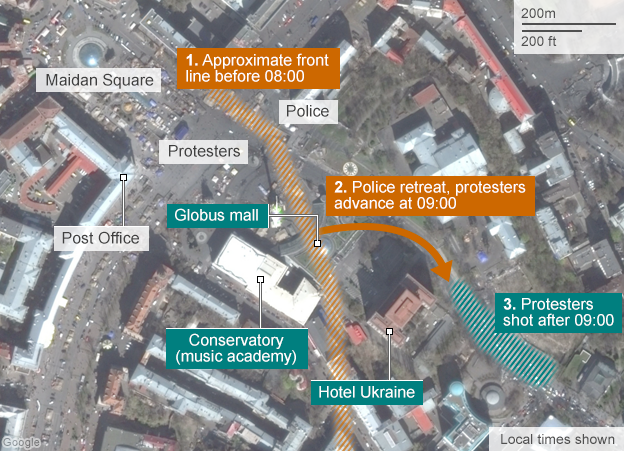
And with that, we’re back to Institutskaya street, February 20th. As I said, that quote above is important. “4 officers … were killed ... between 8.00 and 9.25 a.m. in Khreshchatyk and Instytutska Streets.” Shooting of protesters happened in Institutskaya, AFTER 9 am.
In other words, protesters fired first, killed some officers and wounded many more, forcing them to retreat from Khreshchatyk (frontline police units were only armed with batons). Then protesters advanced on the armed Berkut units (two Berkut officers were among those killed). Then, several Berkut officers finally opened fire in return.
Not quite the picture we got on TV, huh?
===
A BBC investigation came to similar conclusions independently (a leaked conversation between Estonian foreign minister and EU foreign affairs chief also pointed in the same direction). BBC even talked to one of the snipers. Although, as I mentioned above, news reports tend to be less reliable, the BBC investigation does match up well with the report above. Here are some quotes:
“The protest leaders, some of whom now hold positions of power in the new Ukraine, insist full responsibility for the shootings lies with the security forces, acting on behalf of the previous government. But one year on, some witnesses are beginning to paint a different picture. … A man we will call Sergei ... tells me he took up position in the Kiev Conservatory, a music academy on the south-west corner of the square.
….
[On the morning of Feb 20th, he] spent some 20 minutes before 07:00 firing on police, alongside a second gunman.
Sergei says ... that his shots at police on the square and on the roof of an underground shopping mall, caused them to retreat.
That morning, Andriy Shevchenko, then an opposition MP and part of the Maidan movement, had received a phone call from the head of the riot police on the square.
Shevchenko contacted the man in charge of security for the protesters, Andriy Parubiy, known as the Commandant of the Maidan.
"I sent a group of my best men to go through the entire Conservatory building and determine whether there were any firing positions," Parubiy says.
...
[Shevchenko says] "I kept getting calls from the police officer, who said: 'I have three people wounded, I have five people wounded, I have one person dead.' And at some point he says, 'I am pulling out.' [riot police at the square were reportedly armed only with shields and batons - ed.]
And he says, 'Andriy I do not know what will be next.' But I clearly felt that something really bad was about to happen."
…
Parubiy, [currently Speaker of Parliament - ed.], says his men found no gunmen in the Conservatory building.
But a photographer who gained access to the Conservatory later in the morning - shortly after 08:00 - took pictures there of men with guns, although he did not see them fire.
Sergei's account also differs from Parubiy's.
"I was just reloading," he told me. "They ran up to me and one put his foot on top of me, and said, 'They want a word with you, everything is OK, but stop doing what you're doing.'"
... Lawyers for the victims and sources in the general prosecutor's office have told the BBC that when it comes to investigating deaths that could not have been caused by the riot police, they have found their efforts blocked by the courts."
[map of the area from BBC’s report. Clearly shows which side was attacking]
===
D) There are plenty of other interesting parts to the Panel’s conclusions, most of them having to deal with the ineptitude and sabotage in the Maidan investigations, essentially finding them biased and unsatisfactory:
“... in certain important respects, the investigations into the Maidan cases lacked practical independence.”
“Mr Bahanets was ... the hands-on leader of the Maidan investigations. He was removed from those investigations by the Prosecutor General, Mr Yarema ...
Mr Scherbyna was Mr Bahanets’ subordinate, ... He received a redundancy notice on 11 September 2014, immediately following his meeting with the Panel ... Thus, six months into the management of the investigations …. when continuity and leadership would have been vital, the two leaders of the Maidan investigations in the PGO were removed from the investigations within weeks of each other. No concerns or reservations had been expressed to either of them about their work and both considered that their removal had had a negative impact on the investigations. The submissions of the PGO to the Panel contained no explanation for these senior staffing changes.
….
The Panel concludes that the number of PGO investigators involved in the Maidan investigations during 2014 was wholly inadequate. ... All save one of the senior prosecutors [initially assigned to the investigation] appear to have been dismissed or removed from the Maidan investigations by October 2014"
“... the authorities undermined the role of public scrutiny in securing accountability and, in addition, failed to satisfy the public’s right to know what happened during the Maidan demonstrations.”
“The Panel considers that substantial progress has not been made in theinvestigations into the violent incidents during the Maidan demonstrations. “
Oh, and here’s one final quote. 992 officers injured, 13 dead… “According to the information before the Panel, no one has been notified of suspicion of killing or injuring a law enforcement officer. ... The Panel obtained no information from the MoI about the nature or progress of those investigations." A BBC journalist can find the snipers, but the government is oblivious to their existence.
=== NOTES
[note 1] Ahem…
“Make America Great Again”... “Hands up don’t shoot”...
Hillary 2016 ...
Hardly anyone in these movements reads any official documents, either.
[note 2] For example, one can also examine the sections of the report pertaining to the supposed brutal mass beating of young students by the riot police on Nov 30th (the event that really started the Maidan). The facts of the report show that students made fewer than 10% of people injured that night (6 of 70+), and in fact fewer students were injured than law enforcement officers. Also, the injuries from the so-called “brutal mass beating” included one suspected fracture and one concussion, the rest being simple bruises and scratches.
[note 3] We can also compare the actions of the “brutal dictator’s goons” at the Maidan to the democratic glory of the US police force.
According to the database at killedbypolice.net, law enforcement officers in the US killed 434 people in the first 137 days of 2016, while 22 law enforcement officers were murdered in the same period (according to database at www.odmp.org). Simple math (85/13 in Ukraine versus 434/22 in USA) shows that US police are roughly 3 times more likely to use deadly force than Yanukovich’s “brutes”.
I wonder, why didn’t Nuland and Co. denounce Obama’s brutality, like they did with Yanukovich? Maybe issue some travel bans to the persons responsible?
Follow us on Facebook! Follow us on Twitter! Donate!